


Deconstructing the “All-Weather” Commercial Label
For commercial event planners, luxury resort operators, and outdoor equipment exporters, acquiring high-capacity shade structures requires navigating a market saturated with vague quality claims. The “All-Weather” designation is frequently applied to standard event shelters, yet field performance under heavy rain, prolonged sun exposure, and high humidity often falls short of expectations.
A genuine all-weather star tent is defined not by marketing terminology, but by the convergence of three strict material engineering metrics: hydrostatic waterproof protection, certified UV radiation blocking, and double-sided anti-mold surface treatments. When deployed at high-end commercial venues, music festivals, or coastal resorts, a star shade structure must maintain its pristine aesthetic and structural integrity through repeated usage cycles.
Understanding how these three protective technologies interact enables procurement teams to source high-yield, long-lasting shelter assets that protect event investments across diverse climates.
1. The Core Performance Triad: Engineering an All-Weather Canopy
Achieving reliable shelter performance in unpredictable outdoor environments requires overlapping material treatments across the fabric matrix.
| Performance Feature | Protection / Resistance | Key Technical Solution |
|---|---|---|
| Waterproof Protection | Resists rain and water penetration | High-density PU/PVC coating + sealed seams |
| UV Protection | Shields the tent from UV exposure | Certified UPF 50+ + UV-blocking treatment |
| Anti-Mold & Dirt Resistance | Helps prevent mold growth and surface contamination | Double-sided protective barrier coating |
1.1. Waterproofing: High-Density Fabric Coatings & Seam Integrity
True water resistance depends on both base fabric density and chemical coating composition. Standard commercial event canopies utilize high-density polyester (e.g., $180\text{ g/m}^2$ base weave) paired with specialized Polyurethane (PU) or Polyvinyl Chloride (PVC) coatings.
-
Hydrostatic Head Standards: To prevent water penetration during heavy downpours, fabrics must exceed a minimum hydrostatic head pressure test threshold of $1,000\text{ mm}$ (with high-grade commercial spec lines achieving total liquid barrier performance).
-
Seam Sealing: Fabric panels cut into aerodynamic star-shaped contours require heat-sealed or factory-taped seams to prevent water seepage along stitch lines under tension.
1.2. UV Protection: Structural Degradation & Radiation Blocking
Prolonged exposure to solar radiation damages untreated synthetic fibers, causing color fading and tensile strength loss.
-
UPF 50+ Certification: High-grade canopy fabrics integrate specialized UV-reflecting additives into the coating matrix, blocking over 98% of harmful UVA and UVB rays.
-
Polymer Stabilization: Anti-UV treatment prevents the base polyester filaments from turning brittle, preserving the fabric’s elasticity and high-tension load capacity over years of sun exposure.
1.3. Anti-Mold and Easy-Clean Surface Treatments
In humid coastal zones or when tents are packed damp during rapid event teardowns, fungal growth poses a major threat to fabric longevity.
-
Double-Sided Protective Coating: Applying protective coatings to both top and bottom fabric surfaces prevents moisture from penetrating the core fibers, blocking mold spore proliferation.
-
Stain & Soil Resistance: Smooth double-sided surface finishes prevent dirt from embedding in the fabric weave, allowing operators to wash down the canopy quickly between event rentals.
2. Technical Q&A: Addressing Common Field Failures in Commercial Event Tents
Q: Why Does a “Waterproof” Rated Tent Still Leak During Heavy Rain?
Water intrusion on a rated canopy typically stems from two structural vulnerabilities rather than base fabric failure:
-
Unsealed Seams under High Tension: Star shade tents rely on tension-fit architecture radiating from a heavy-duty central support pole to outer ground anchors. High tension stretches needle holes along panel seams. If these seams lack factory-applied waterproof seam tape, rainwater under pressure will seep through stitch lines.
-
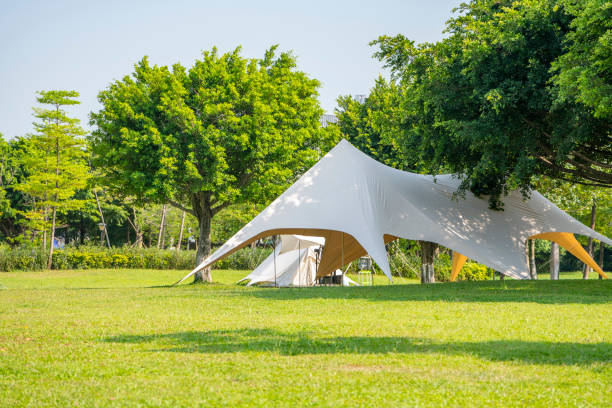
Water Pooling Caused by Fabric Sagging: Inadequate center pole tension or low-density fabric elongation allows water to pool in flat canopy sections. The weight of accumulated water exceeds the fabric’s hydrostatic pressure limit, forcing moisture through the weave. Aerodynamic star contours and rigid central support poles maintain steep slopes that shed water continuously.
Q: Do UV Protection Coatings Degrade Over Time with Regular Use?
Yes, all surface coatings experience gradual wear, but rate of degradation depends on engineering quality.
Standard surface-sprayed UV coatings rub off quickly due to mechanical friction during folding, packing, and wind vibration. In contrast, commercial-grade star tent fabrics feature UV-inhibiting compounds embedded directly into the primary PU or PVC coating layer during extrusion. This integrated bonding ensures the canopy retains its UPF rating and tensile strength across dozens of deployment cycles.
Q: Can Mold-Damaged Tent Fabric Be Restored for Commercial Renting?
Once mold spores penetrate the core fibers of an untreated polyester weave, the structural fibers suffer permanent microscopic degradation. While surface discoloration can be scrubbed off using specialized mild cleansers, serious fungal damage compromises fabric strength and leaves faint staining that degrades the visual appeal required for luxury events.
The most effective strategy is preventative engineering: utilizing double-sided anti-mold barrier coatings that prevent fungal hyphae from anchoring into the internal thread matrix, ensuring the fabric wipes clean after wet deployments.
3. Commercial Deployment Matrix: Evaluating Structural Specs for Venue Operations
Selecting a star shade tent for commercial rental fleets or fixed hospitality venues requires matching structural components to operational demands:
| Engineering Feature | Standard Lightweight Event Canopy | High-Performance Commercial Star Tent | Operational Impact on Venue ROI |
| Support Architecture | Multi-frame aluminum accordion legs | Heavy-duty powder-coated single steel pole | High wind resistance & rust protection; fewer failure points |
| Fabric Density & Coating | Lightweight ($100 – 140\text{ g/m}^2$) thin PU | High-density ($180+\text{ g/m}^2$) PU/PVC double-coated | 100% waterproof protection & tear-resistant tension stability |
| Wind Load Distribution | Flat roof panels subject to wind lift | Aerodynamic star-shaped tension contour | Smoothly dissipates wind forces, preventing canopy deformation |
| Assembly Efficiency | Complex multi-person frame alignment | Optimized tension-fit setup architecture | Reduces labor crew size and speeds up site installation |
Technical Knowledge Summary
Evaluating an all-weather star tent requires looking beyond general marketing terms and verifying quantifiable technical specifications. True weatherproofing relies on the combination of high-density base fabrics, heat-sealed seams capable of handling high tension, certified UPF 50+ UV protection, and double-sided anti-mold barrier coatings. Supported by heavy-duty powder-coated steel center support structures and aerodynamic tension profiles, fully specified star shade tents provide reliable rain shedding, wind resistance, and long-term durability across demanding commercial event applications.
Optimize Your Event Shelter Infrastructure
Evaluating canopy options for an upcoming rental season, resort expansion, or commercial venue upgrade? Contact our technical sales team with your target site requirements, installation formats, and climate conditions to receive detailed fabric spec sheets, wind load test ratings, and customized commercial supply quotes.