


Choosing between a party tent vs event canopy can significantly affect the safety, appearance, and operating costs of an outdoor event. Although both products provide temporary shelter, they serve different purposes and use different structural designs.
Commercial party tents are generally designed for larger events, extended setups, and more comprehensive enclosure options. They often feature modular frames, larger roof structures, and removable sidewalls. Event canopies, especially pop-up models, prioritize portability, quick assembly, and convenient transportation.
No entanto, not every party tent is suitable for long-term outdoor installation, and not every event canopy is limited to fair-weather use. Actual performance depends on frame engineering, fabric specifications, anchoring systems, environmental conditions, and manufacturer-approved operating limits.
Para locadoras de eventos, wedding planners, distributors, and commercial buyers, understanding these differences helps prevent unsuitable purchases. This guide compares party tents and event canopies across terminology, construção de moldura, weather durability, appearance, and purchasing considerations.
1. Clarifying Terminology: Commercial-Grade Party Tents vs. Lightweight Pop-Up Canopies
The terms barraca de festa e event canopy sometimes overlap in the outdoor shelter market. A party tent may also be marketed as an event tent, while a pop-up canopy can serve as a small event shelter.
Portanto, buyers should compare the actual structure and intended application rather than relying on product names alone.
1.1 What Is a Commercial Party Tent?
A commercial party tent is a larger outdoor shelter designed for gatherings, celebrations, exposições, restauração, and other organized events.
Many commercial models use modular frame systems. Buyers can select different widths, lengths, roof styles, and enclosure configurations according to project requirements.
Common features include:
- Modular frame components for different tent sizes.
- Larger roof structures for event coverage.
- Optional removable sidewalls and entrance panels.
- Different roof profiles, including high-peak and traditional styles.
- Fabric options for different environmental and branding requirements.
- Configurations for weddings, banquets, exposições, and corporate events.
Some commercial party tents support repeated installation and extended deployment. No entanto, suitability for continuous outdoor use must be confirmed through the manufacturer’s specifications and engineering documentation.
1.2 What Is an Event Canopy or Pop-Up Tent?
An event canopy is a broad product category that includes lightweight portable shelters. Pop-up canopies are especially common at markets, feiras, promoções ao ar livre, and temporary sales events.
Most pop-up models use a folding frame that expands when users pull the legs apart. The canopy fabric attaches to the top of the frame.
Typical features include:
- Folding or collapsible frame structures.
- Quick setup and takedown.
- Compact transportation and storage.
- Lightweight construction.
- Open-sided designs or optional sidewalls.
- Convenient branding surfaces for promotional activities.
These products are practical when portability and setup speed are more important than large-scale coverage or extended deployment.
1.3 Key Differences at a Glance
| Fator de comparação | Commercial Party Tent | Pop-Up Event Canopy |
|---|---|---|
| Main purpose | Casamentos, banquets, large gatherings, exposições | Markets, promoções, small outdoor events |
| Frame structure | Modular structural frame | Folding scissor-truss frame |
| Typical scale | Medium to large configurations | Usually small portable configurations |
| Assembly | Component-based installation | Quick folding-frame setup |
| Transportation | Requires more storage and transport planning | Designed for easier transport |
| Sidewalls | Often available in multiple configurations | Optional sidewalls on many models |
| Personalização | Roof shape, dimensões, walls, entradas, marca | Canopy colors, printed graphics, accessories |
| Deployment | Depends on engineering and approved conditions | Generally suited to temporary event use |
| Main purchasing priority | Coverage, configuration, structural performance | Portability, setup speed, convenience |
The distinction is mainly about design purpose. Buyers should still check each model’s specifications before comparing performance.
2. Structural Integrity: Heavy Extruded Aluminum Frames vs. Scissor-Truss Steel Legs
Frame construction is one of the most important differences between commercial party tents and portable pop-up canopies.
The frame supports the roof fabric, transfers environmental loads, and maintains the shelter’s shape. Its performance depends on material properties, section geometry, joints, bracing, and anchoring.
2.1 Commercial Party Tents: Modular Structural Frames
Many commercial party tents use modular aluminum frame systems. Aluminum is widely used because it offers a useful balance between strength, weight, corrosion resistance, and fabrication flexibility.
Extruded aluminum profiles can be designed with different cross-sections to meet structural requirements.
Important design factors include:
Profile dimensions: Larger or specially shaped profiles can provide greater section stiffness, depending on their geometry and material properties.
Wall thickness: The thickness of the frame material affects its resistance to deformation and local damage.
Connection design: Joints, bolts, brackets, and connectors transfer forces between structural members.
Roof geometry: The roof profile influences how loads travel through the frame and toward its supports.
Anchoring system: Ground anchors, lastro, and other approved fixing methods help resist movement and uplift.
Some commercial party tent systems also use steel components or mixed-material structures. Portanto, buyers should evaluate the complete frame design rather than assume that every commercial tent uses aluminum.
2.2 Pop-Up Canopies: Folding Scissor-Truss Frames
Pop-up event canopies commonly use a folding scissor-truss structure.
The frame contains interconnected metal bars that expand and contract during setup. This mechanism lets users open the shelter without assembling each structural component separately.
Common materials include steel and aluminum, depending on the product design and price range.
The main advantages include:
- Fast deployment and folding.
- Compact storage.
- Convenient transportation.
- Fewer separate components during setup.
- Practical use for temporary promotional activities.
No entanto, folding joints and lightweight frame members require careful handling. Their structural performance varies significantly between models.
A commercial-grade pop-up canopy may offer stronger construction than a basic consumer model. Buyers should not judge its performance solely by the fact that it uses a folding frame.
2.3 Why Frame Material Alone Does Not Determine Strength
It is tempting to assume that aluminum party tents always outperform steel pop-up canopies. This is not a reliable engineering comparison.
Aluminum and steel have different mechanical properties. Steel generally has a higher elastic modulus, while aluminum offers lower density. No entanto, the actual performance of a tent frame depends on its complete structural configuration.
Por exemplo, a well-designed steel component may outperform an undersized aluminum component in a particular loading condition.
Buyers should compare:
- Material grade and specifications.
- Frame profile dimensions.
- Wall thickness.
- Connection and joint design.
- Bracing and reinforcement.
- Structural load ratings.
- Installation and anchoring requirements.
For projects exposed to wind or snow, request engineering documentation that identifies the approved loading conditions. Do not assume that a material description alone proves weather resistance.

3. Weather Durability: Multi-Day Outdoor Deployment vs. Temporary Same-Day Use
Weather exposure is a major consideration when selecting an outdoor event shelter.
A tent used for a one-day promotional event faces different operating requirements from a structure installed for a multi-day wedding, exhibition, or seasonal venue.
No entanto, deployment duration alone does not determine weather suitability. Buyers must consider the actual environmental conditions and the manufacturer’s operating instructions.
3.1 Commercial Party Tents for Planned Outdoor Events
Commercial party tents can be configured for larger events and longer deployment periods.
Depending on their structural design and specifications, some models may support multi-day outdoor use.
Important weather-related considerations include:
Wind resistance
Wind creates lateral forces and uplift that affect the roof, frame, conexões, and anchoring system. A tent’s wind performance depends on its complete structural design and installation.
Rain protection
Roof shape, fabric waterproofing, construção de costura, and drainage details influence how effectively a tent manages rainfall.
Snow loading
Snow can accumulate on the roof and create significant downward loads. A tent should only be used in snow conditions when its manufacturer provides suitable snow-load specifications and operating instructions.
Fabric durability
Outdoor fabric performance depends on material composition, revestimento, Resistência UV, construção de costura, e manutenção.
Commercial party tents should not automatically be treated as permanent structures. Extended deployment requires confirmation of the product’s approved use conditions.
3.2 Pop-Up Canopies for Temporary Activities
Pop-up canopies are commonly selected for short-duration activities because they are easy to transport and install.
Typical applications include:
- Outdoor markets.
- Product demonstrations.
- Sporting events.
- Temporary registration stations.
- Promotional booths.
- Small outdoor exhibitions.
Their lightweight folding structures make them convenient for mobile businesses and event teams.
No entanto, portability does not eliminate weather risks. Wind can create uplift and overturning forces, while heavy rain may cause water pooling if the roof is not properly tensioned or designed for the conditions.
Users should follow the manufacturer’s wind and weather limitations. They should also take down or secure the canopy when conditions exceed its approved operating limits.
3.3 Weather Resistance: What Should Buyers Compare?
| Weather Factor | Commercial Party Tent | Pop-Up Event Canopy |
|---|---|---|
| Rain protection | Depends on roof fabric, costuras, and drainage design | Depends on canopy fabric, costuras, and roof tension |
| Wind performance | Must be verified through structural specifications | Must be verified through model-specific limits |
| Snow loading | Requires explicit approved snow-load specifications | Generally should not be assumed suitable |
| UV exposure | Depends on fabric and coating specifications | Depends on fabric and coating specifications |
| Multi-day deployment | Possible for models approved for the conditions | Depends on manufacturer approval and weather limits |
| Anchoring | Project-specific anchoring or ballast system | Model-specific stakes, pesos, or other approved fixing methods |
3.4 Why Proper Anchoring Is Essential
A strong frame cannot provide safe performance without suitable anchoring.
Wind may push against the tent’s sidewalls and roof. It can also create uplift that attempts to lift the structure from the ground.
The correct anchoring method depends on the installation surface and the tent’s design.
Por exemplo:
- Grass installations may use approved ground stakes or anchors.
- Concrete surfaces may require engineered ballast or other approved fixing systems.
- Temporary event venues may have restrictions on drilling or ground penetration.
- Large commercial tents may require project-specific anchoring calculations.
Buyers should obtain installation instructions before deployment. They should also confirm whether the supplied anchoring accessories match the intended surface and operating conditions.
Safety note: Never use a party tent or pop-up canopy beyond its stated environmental limits. Do not assume that adding extra weights makes an otherwise unsuitable tent safe in strong winds or heavy snow. Follow manufacturer instructions and local safety requirements.
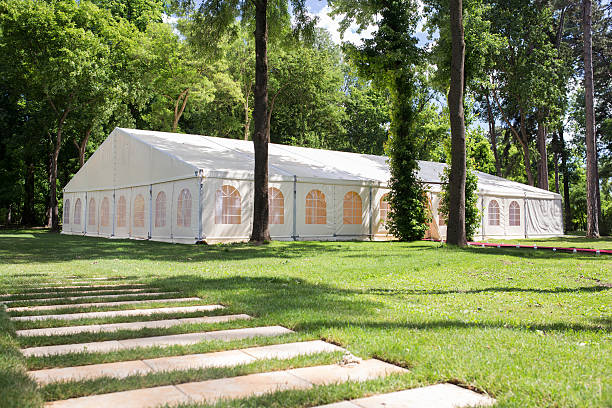
4. Aesthetic Presence and Custom Branding Potential
Beyond structural performance, appearance can influence how an outdoor shelter supports an event’s overall presentation.
A wedding venue, luxury hospitality project, and promotional market booth have different visual requirements. The tent should match the brand identity and the atmosphere of the event.
4.1 Party Tents: Larger Roof Profiles and Event-Focused Appearance
Commercial party tents often provide more opportunities for architectural-style presentation.
Depending on the frame system, buyers may select different roof profiles and enclosure configurations.
Common options include:
High-peak designs
A raised central roof creates a distinctive silhouette. This style is often used for weddings, formal celebrations, and hospitality events.
Traditional gable roofs
The familiar pitched roof creates a practical and recognizable event structure.
Clear-span configurations
Some commercial frame systems are designed to provide open interior space without internal support poles. This can help with banquet layouts, exhibition arrangements, and guest circulation.
Custom sidewalls
Removable walls can help define the event space and support different entrance or window configurations.
The availability of these features depends on the manufacturer’s product range and engineering design.
4.2 Pop-Up Canopies: Practical Branding for Promotional Events
Pop-up canopies offer convenient branding opportunities for businesses that attend multiple events.
Their roof panels and optional sidewalls provide visible areas for logos, campaign graphics, e mensagens promocionais.
Common customization options include:
- Printed logos.
- Custom canopy colors.
- Branded valances.
- Printed sidewalls.
- Carrying bags.
- Accessories for display and storage.
These options make pop-up canopies useful for exhibitors, retailers, sports teams, and mobile service providers.
No entanto, their visual presentation usually emphasizes a compact booth or promotional station rather than a large event venue.
4.3 Customization Comparison
| Customization Item | Commercial Party Tent | Pop-Up Event Canopy |
|---|---|---|
| Overall dimensions | Multiple modular configurations may be available | Commonly based on folding-frame sizes |
| Roof profile | High-peak, gable, and other available styles | Usually a compact canopy roof |
| Sidewalls | Full or partial enclosure options | Optional side panels |
| Entrance design | May support dedicated entrances and openings | Usually simple open or panel-based access |
| Logo branding | Roof, valance, and wall branding options | Roof and sidewall printing |
| Event appearance | Suitable for larger venue presentation | Suitable for branded booths and temporary stations |
For B2B buyers, the right customization strategy depends on how the shelter will be used, transported, installed, and presented to customers.
5. Buyer’s Decision Matrix: When to Invest in Party Tents vs. Canopies
The best choice depends on more than the initial purchase price.
Event rental companies, distributors, and venue operators should evaluate the total operating requirements of the product. These include transportation, mão de obra de instalação, armazenar, manutenção, expected usage frequency, and weather-related risks.
5.1 Choose a Commercial Party Tent for Larger Events
A commercial party tent may be the better investment when the project requires:
- Larger covered areas.
- Multiple roof and sidewall configurations.
- Wedding and banquet layouts.
- Corporate events and exhibitions.
- More structured installation planning.
- Repeated use across organized events.
- A coordinated architectural appearance.
Para locadoras, modularity can also provide operational flexibility. Compatible components may allow the business to serve different event sizes with a suitable inventory.
Antes de comprar, confirm whether the frame system supports the required dimensions and whether the manufacturer provides relevant structural and installation documentation.
5.2 Choose a Pop-Up Canopy for Mobile and Short-Term Activities
A pop-up canopy is often more practical when the main priorities are:
- Fast setup and removal.
- Easy transportation.
- Compact storage.
- Small booth coverage.
- Mobile promotional activities.
- Frequent relocation between venues.
- Lower initial equipment requirements.
For market vendors and promotional teams, portability can reduce setup complexity.
No entanto, buyers should still compare frame quality, fabric specifications, replacement parts, and the manufacturer’s weather limitations.
5.3 Party Tent vs. Event Canopy: Purchasing Decision Matrix
| Purchasing Requirement | Commercial Party Tent | Pop-Up Event Canopy |
|---|---|---|
| Large wedding reception | Strong fit | Usually limited by size and configuration |
| Outdoor banquet | Strong fit | More suitable for small service areas |
| Trade show booth | Suitable for larger exhibition spaces | Strong fit for portable booths |
| Farmers’ market stall | May be excessive | Strong fit |
| Corporate outdoor event | Suitable for larger installations | Suitable for small promotional stations |
| Multi-day deployment | Possible when approved for conditions | Only when approved by the manufacturer |
| Frequent transport | Requires more logistics | Strong fit |
| Modular expansion | Available in some systems | Usually more limited |
| Initial investment | Generally higher for comparable large-scale coverage | Often lower for compact models |
5.4 Five Questions to Ask Before Ordering
Before selecting a party tent or event canopy, B2B buyers should clarify five points.
1. How much covered space does the event require?
Estimate the number of guests, equipment, mobília, walkways, and service areas. Do not select a tent based only on its advertised dimensions.
2. How long will the tent remain installed?
A same-day promotional booth and a multi-day wedding installation have different operational requirements.
3. What weather conditions may occur?
Consider wind exposure, rainfall, temperature, and possible snow. Request model-specific operating limits and supporting documentation.
4. What installation surface is available?
Grass, solo, asfalto, and concrete may require different anchoring solutions. Confirm the approved fixing method before purchasing.
5. What customization does the project require?
Discuss dimensions, roof profiles, sidewalls, entradas, fabric colors, and printed branding with the supplier.
5.5 Evaluate Total Cost of Ownership, Not Just Unit Price
The purchase price is only one part of the investment.
For commercial buyers, total ownership costs may include:
- Transportation and delivery.
- Installation and dismantling labor.
- Storage space.
- Cleaning and maintenance.
- Replacement fabric and frame components.
- Anchoring accessories.
- Inspection and repair.
- Expected service life under the intended operating conditions.
A portable canopy may offer a lower entry cost, while a modular commercial party tent may provide more configuration options for a rental or venue business.
The best investment depends on expected utilization, operating conditions, and the number of events the equipment must support.
Conclusão: Choose the Shelter That Matches Your Event Requirements
The main difference in the party tent vs event canopy comparison is the balance between structural configuration, portability, coverage, e uso pretendido.
Commercial party tents are generally better suited to larger organized events that require modular configurations, substantial covered areas, and coordinated enclosure options. Pop-up event canopies are more practical for mobile vendors, promotional booths, and temporary activities where fast setup and easy transportation matter most.
Neither product should be assumed safe in all weather conditions. Frame material, structural design, ancoragem, fabric performance, and manufacturer-approved operating limits must guide the final decision.
For event organizers and commercial buyers, selecting the right shelter starts with understanding the project rather than comparing product names or prices alone.
Upal provides custom-designed party tent solutions for different event and commercial applications. When planning your next project, share the required dimensions, roof style, installation environment, and branding needs with the team to identify a suitable tent configuration.