


Distributeurs de matériel d'extérieur, agents d'approvisionnement du complexe, et les responsables de marques de camping commercial comprennent que les spécifications des matières premières dictent directement la rentabilité du produit et la longévité sur le terrain.. Lors de la recherche d’abris familiaux ou de structures événementielles de grande capacité, les équipes d'ingénierie doivent aller au-delà des images de base des produits pour évaluer les paramètres textiles exacts. Spécifiquement, les agents d'achat d'entreprise sont souvent confrontés à une question critique en matière de fabrication: “Comment les tissus Oxford 150D par rapport aux tissus Oxford 210D modifient-ils les performances d'un tissu haute capacité tente dôme extérieure conception? En outre, quelle norme de polyuréthane (Unité centrale) un revêtement imperméable est nécessaire pour satisfaire divers scénarios d'utilisation commerciale sans surgonfler nos coûts d'approvisionnement?”
La sélection d'une mauvaise combinaison de textiles peut entraîner des échecs sur le terrain, comme la déchirure du tissu lors de vents forts en montagne ou les fuites d'eau lors des averses saisonnières. Inversement, la sur-spécification de matériaux lourds pour les domaines récréatifs de base augmente inutilement le poids d'expédition et réduit considérablement vos marges bénéficiaires au détail.. Ce guide d'approvisionnement complet explique l'importance technique des comptes Denier, explore les normes de charge hydrostatique en PU, et vous aide à adapter la gamme de tissus parfaite à votre public cible..
La signification technique du denier: 150D contre. 210Tissus D Oxford
Le paramètre textile connu sous le nom “Denier” (abrégé en “D”) mesure la densité de masse linéaire exacte d'un filament de fil individuel, représentant spécifiquement le poids en grammes d'un brin de fil continu de 9 000 mètres. Une valeur denier plus élevée signifie un diamètre de fil plus épais, ce qui se traduit directement par une plus grande résistance à la perforation, résistance à la déchirure plus élevée, et un poids de tissu accru.
Pour le camping récréatif ou les festivals de courte durée, un tissu Oxford 150D offre un équilibre exceptionnel entre faible poids et durabilité fiable. Les modèles haut de gamme présentent des configurations 150D étroitement tissées combinées à des blocages solaires UV50+ et à des poteaux de support légers en alliage d'aluminium de la série 7000., créant un incroyablement résilient, 14.2structure de 1 kg pouvant accueillir confortablement jusqu'à cinq adultes. Inversement, les détaillants à petit budget associent souvent le polyester 150D standard à des tissus lourds, poteaux en fibre de verre cassants pour créer un faible coût, abri d'entrée de gamme.
Lorsque votre projet exige une robustesse maximale, comme l'établissement de champs de glamping commerciaux permanents ou l'organisation d'expéditions quatre saisons difficiles, il est fortement recommandé de passer à un tissu Oxford 210D ou plus épais.. Pour abris industriels lourds, les fabricants peuvent même passer à un polyester robuste enduit de PVC double face de 850 g/m² pour offrir une protection maximale.
Décodage des indices d'étanchéité PU: La norme de charge hydrostatique
Les capacités d'étanchéité d'un tente dôme extérieure sont quantifiés par son polyuréthane (Unité centrale) épaisseur du revêtement, que les laboratoires mesurent en utilisant des millimètres de pression de charge hydrostatique (mmH2O). Cette métrique indique la hauteur précise de la colonne verticale d'eau sous pression qu'un échantillon de tissu peut supporter avant que les premières micro-gouttelettes ne pénètrent dans le joint textile..
Une cote de PU 3000 mm représente la référence de l'industrie en matière de fiabilité., protection contre les fortes pluies. Cette couche de membrane protectrice scelle les coutures de la tente contre les pluies torrentielles constantes, bloquant l'humidité même lorsque les forces du vent poussent l'eau directement contre le double toit extérieur.
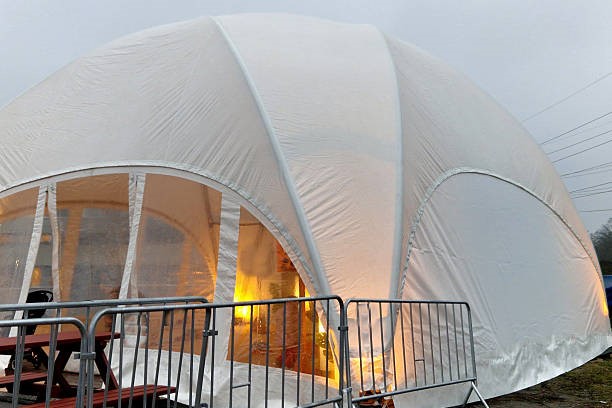
Pour les structures spécialisées à usage intensif, tels que les abris gonflables commerciaux modernes, les équipes d'ingénierie utilisent du PVC de qualité supérieure ou des matériaux Oxford haute densité spécialisés allant de 0,25 mm à 1,0 mm d'épaisseur. Ces couches de tissus industriels lourds offrent une étanchéité exceptionnelle, ignifuge fiable, et des blocages UV stables pour empêcher la dégradation du tissu lors de déploiements extérieurs prolongés.
Cadre de sélection stratégique des matériaux par segmentation du marché
Pour maximiser votre retour sur investissement, votre service d'achat doit aligner les spécifications du tissu directement sur le cas d'utilisation attendu du produit.
Le marché récréatif d’entrée de gamme
-
Public cible: Campeurs occasionnels du week-end, participants au festival de musique d'été, et campeurs familiaux dans la cour.
-
Spécifications idéales: 150D Tissu en polyester ou Oxford associé à un revêtement PU de 1 500 mm à 2 000 mm et des poteaux de support en fibre de verre économiques.
-
Avantage d'approvisionnement: Ce mélange de matériaux maintient les coûts de fabrication à un faible niveau, minimise le poids d'expédition, et offre un prix de détail abordable pour les utilisateurs occasionnels qui campent uniquement par beau temps.
Le marché de la vente au détail haut de gamme et des tournées étendues
-
Public cible: Marques grand public haut de gamme, campeurs terrestres fréquents, et voyagistes de plusieurs jours en pleine nature.
-
Spécifications idéales: Renforcé, tissu Oxford haute densité 150D à 210D bénéficiant d'un indice PU vérifié de 3 000 mm, Traitement UV50+, et léger, poteaux en aluminium de qualité aérospatiale série 7000.
-
Avantage d'approvisionnement: Cette combinaison offre une résistance supérieure au vent et une protection complète contre la pluie., permettant aux marques de vente au détail d'exiger un prix plus élevé basé sur une durabilité vérifiée contre les intempéries.
Le marché du Glamping Commercial et de l’Événement Professionnel
-
Public cible: Eco-resorts de luxe, camps de projets de construction éloignés, et prestataires d'hôtellerie extérieure haut de gamme.
-
Spécifications idéales: Tissus Oxford ultra-lourds 210D à 600D ou matériaux enduits de PVC double face de qualité industrielle de 850 g/m² construits sur des structures à poutres d'air ou des cadres en acier épais.
-
Avantage d'approvisionnement: Cette approche robuste maximise la durée de vie des structures sur plusieurs saisons, réduit les coûts de maintenance continue, et assure la sécurité totale des clients dans des conditions météorologiques extrêmes.
Conclusion: Pérennisez votre approvisionnement en équipements de plein air
En conclusion, développer une marque de plein air à succès ou équiper un camping commercial nécessite un examen attentif du poids des tissus et des spécifications de revêtement chimique..
Arrêtez de risquer votre capital de développement et la réputation de votre marque à bas prix, tentes à parois minces qui fuient lors de tempêtes soudaines ou se déchirent le long des coutures lors de rafales de vent modérées. Mise à niveau de votre inventaire vers un inventaire correctement configuré tente dôme extérieure la disposition garantit une intégrité structurelle fiable, protection imperméable prévisible, et une excellente résistance aux UV en toutes saisons. Nous concevons chaque disposition de tissu et surveillons chaque application de revêtement pour garantir que votre équipement passe parfaitement les audits de sécurité rigoureux sur le terrain.. Contactez notre division de fabrication de textiles d'extérieur dès aujourd'hui pour soumettre vos plans de produits et obtenir un devis de production détaillé..