


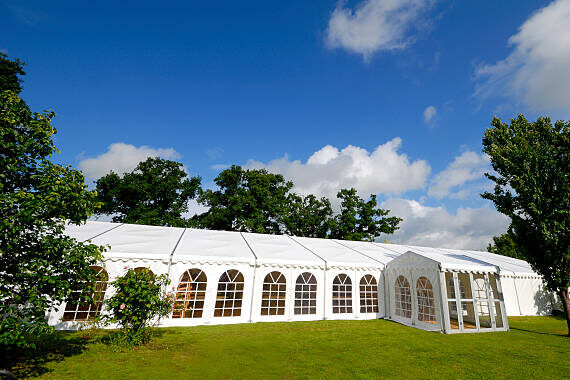
For event rental companies, purchasing a separate tent for every event size can create unnecessary inventory costs. A wedding may require a 10 × 15m structure, while a corporate event may need a 10 × 30m covered space. However, buying multiple independent tents for these different requirements increases storage needs, transportation expenses, and equipment investment.
Modular party tents offer a more flexible solution. They use standardized structural sections, connection systems, and interchangeable components to create different tent lengths from a shared inventory. Rental businesses can combine or extend tent sections according to event requirements.
With a properly designed modular tent system, one standardized frame configuration can support multiple layouts. This approach helps rental companies improve equipment utilization, simplify inventory management, and respond to changing event demands.
This guide explains how modular party tents work, how to compare 3m and 5m bay distances, and how to plan an efficient initial tent fleet.
1. What Is a Modular (Sectional) Party Tent System?
A modular party tent system is a sectional structure designed around standardized frame dimensions and repeatable connection points. Instead of manufacturing every tent as a completely independent structure, manufacturers divide the tent into reusable structural sections.
Each section typically includes a defined roof-frame arrangement, supporting components, and connection hardware. Rental operators can connect multiple sections to create longer structures.
1.1 Understanding the Basic Modular Structure
A typical modular party tent consists of several structural elements:
- Aluminum frame: Main beams, rafters, columns, and supporting members.
- Bay sections: Repeated structural units that determine the tent’s longitudinal length.
- Connection hardware: Bolts, plates, connectors, and other compatible fastening components.
- Roof covers: Fabric panels designed for specific frame dimensions.
- Sidewalls: Removable or interchangeable enclosure panels.
- Accessories: Doors, windows, gutters, flooring interfaces, and other optional components.
The bay distance refers to the spacing between consecutive structural frames along the tent’s length.
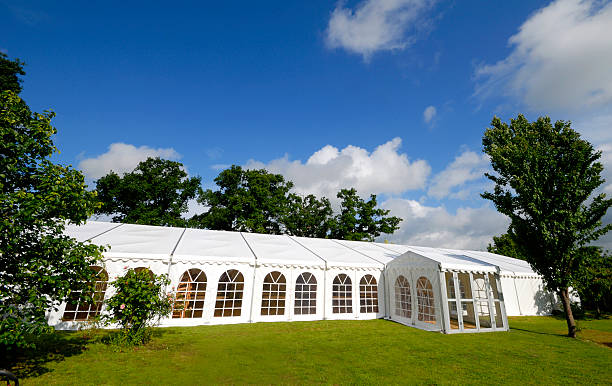
For example, a tent with a 5m bay distance can use repeated 5m sections to extend its overall length. A compatible system may also offer end frames and intermediate sections to accommodate different configurations.
1.2 How Modular Tent Lengths Are Created
The main advantage of sectional construction is repeatability.
A manufacturer establishes a standard frame width and bay distance. Rental operators then combine compatible sections to create different lengths.
For example, a system with a 10m clear width and suitable 5m modules may support configurations such as:
| Tent Size | Width | Length | Example Module Layout |
|---|---|---|---|
| 10 × 15m | 10m | 15m | 3 × 5m sections |
| 10 × 20m | 10m | 20m | 4 × 5m sections |
| 10 × 30m | 10m | 30m | 6 × 5m sections |
These dimensions are illustrative. Actual configurations depend on the manufacturer’s available end frames, intermediate frames, roof-cover design, and structural system.
Not every modular tent can be extended indefinitely. Maximum length, anchoring requirements, fabric drainage, wind resistance, and local engineering regulations must all be considered.
1.3 Modular Tents vs. Independent Tent Structures
The difference is mainly in how operators manage and reuse equipment.
| Comparison | Independent Tents | Modular Party Tents |
|---|---|---|
| Configuration | Fixed dimensions | Multiple compatible layouts |
| Frame inventory | Separate frame sets | Shared standardized sections |
| Expansion | Often requires another tent | Add compatible sections |
| Accessories | May be model-specific | Can be shared within a compatible system |
| Storage | More separate equipment sets | Potentially more consolidated inventory |
| Rental flexibility | Limited by available sizes | More adaptable to event requirements |
For rental businesses with changing customer requirements, modular construction can make inventory planning more efficient.
2. Flexibility Benefits for Event Rental Operations
Event rental companies rarely serve customers with identical space requirements. Wedding receptions, exhibitions, corporate functions, festivals, and private celebrations all require different layouts.
Modular party tents help operators respond to these variations without maintaining a completely separate tent structure for every event size.
2.1 One Frame System, Multiple Event Sizes
A standardized aluminum frame system can support several tent lengths when the components are designed for compatibility.
Consider a rental company offering a 10m-wide modular tent system.
Its available sections could be combined to create:
- 10 × 15m: Suitable for smaller receptions, private celebrations, and temporary dining areas.
- 10 × 20m: Suitable for medium-sized corporate events and wedding receptions.
- 10 × 30m: Suitable for larger gatherings, exhibitions, and festival activities.
The same basic frame inventory may serve these different requirements.
This reduces the need to purchase multiple complete tent systems, provided the structural design and component compatibility support the selected configurations.
2.2 Better Adaptation to Changing Event Requirements
Customer requirements can change during the planning process.
An event organizer may initially request a small covered dining area. Later, the organizer may add a stage, catering section, registration area, or additional seating.
With an expandable tent structure, rental operators may extend the tent by adding compatible bays.
This flexibility supports several operational benefits:
- Adjust tent length according to confirmed attendance.
- Create separate functional zones under one roof.
- Expand existing structures when event requirements increase.
- Reuse the same frame components across different projects.
- Reduce the need to maintain rarely used tent sizes.
However, expansion should always follow the manufacturer’s approved configuration. Operators should never add sections beyond the system’s engineered limits.
2.3 More Efficient Transportation and Installation Planning
Standardized components can simplify transportation planning because rental teams handle fewer unique frame types.
Repeated structural sections also make equipment identification and assembly procedures easier to standardize.
For rental companies managing multiple projects, this can improve:
- Loading and unloading organization.
- Component counting and inspection.
- Crew training and assembly consistency.
- Spare-part allocation.
- Equipment maintenance and replacement planning.
The actual savings depend on packing dimensions, connection design, crew experience, and transportation arrangements.
3. Standard Bay Distances: 3m vs. 5m and Structural Integrity
Bay distance is an important factor when selecting modular party tents. It affects the number of structural frames, roof-cover segmentation, connection details, and installation procedures.
Two common options in modular tent planning are 3m and 5m bay distances. Neither option is automatically better for every project.
3.1 3m Bay Distance: More Frequent Structural Sections
A 3m bay distance creates shorter intervals between consecutive frames.
This arrangement may be suitable for projects that prioritize smaller sectional increments or require more frequent structural support points.
Potential advantages include:
- More flexible length combinations in 3m increments.
- Shorter spans between repeated frame positions.
- More frequent opportunities for intermediate support.
- Potentially easier adaptation to certain site layouts.
However, a shorter bay distance usually requires more repeated structural sections for the same overall tent length.
For example, a 30m-long tent based on 3m modules would require ten 3m sections, subject to the system’s end-frame configuration.
More frames and connections may increase component quantities, assembly steps, and transportation volume.
3.2 5m Bay Distance: Larger Modular Increments
A 5m bay distance creates longer intervals between consecutive frames.
It can be attractive for rental companies that frequently install medium or large structures and prefer fewer repeated sections.
Potential advantages include:
- Fewer repeated bays for a given tent length.
- Larger configuration increments.
- Potentially fewer frame assembly operations.
- A simpler inventory structure for selected standard layouts.
For example, a 30m-long tent based on 5m modules would use six 5m sections.
However, longer bay spacing may require different member sizes, connection details, and structural calculations. It does not automatically mean a lighter, stronger, or more economical structure.
3.3 3m vs. 5m Bay Distance: Which Should You Choose?
| Evaluation Factor | 3m Bay Distance | 5m Bay Distance |
|---|---|---|
| Module increment | Smaller | Larger |
| Number of sections for the same length | More | Fewer |
| Layout adjustment | More granular | Based on larger increments |
| Frame quantity | Generally higher | Generally lower |
| Installation operations | Potentially more | Potentially fewer |
| Structural requirements | Project-specific | Project-specific |
| Suitable planning focus | Flexible length increments | Efficient larger sections |
The best choice depends on the rental company’s typical event sizes, available storage, transportation capacity, and structural requirements.
3.4 Structural Integrity Must Come Before Modular Flexibility
A modular tent must remain structurally reliable in every approved configuration.
Adding more sections changes the overall structure and may affect its exposure to wind, rain, and other environmental loads.
Before purchasing a modular tent system, buyers should evaluate the following factors:
Frame material and dimensions
Aluminum alloy frames are commonly used in commercial event tents because of their strength-to-weight characteristics and corrosion resistance. However, the specific alloy, temper, cross-section, and connection design determine actual performance.
Connection strength
Bolts, plates, connectors, and joints must transfer structural forces between adjacent sections. Loose or incompatible connections can compromise the complete structure.
Wind and snow loading
Structural design should account for the intended installation environment and applicable local requirements. Wind exposure, snow accumulation, roof geometry, and anchoring conditions can affect the design.
Ground anchoring
Anchoring systems must match the ground conditions and project requirements. Concrete surfaces, grass, asphalt, and temporary event platforms may require different solutions.
Rainwater drainage
Longer structures require careful roof geometry and drainage planning. Gutters and roof connections should prevent water accumulation and uncontrolled runoff.
Buyers should request structural drawings, load calculations, approved configuration limits, and installation instructions before placing an order.
4. Interchangeable Components and Reduced Inventory Holding Costs
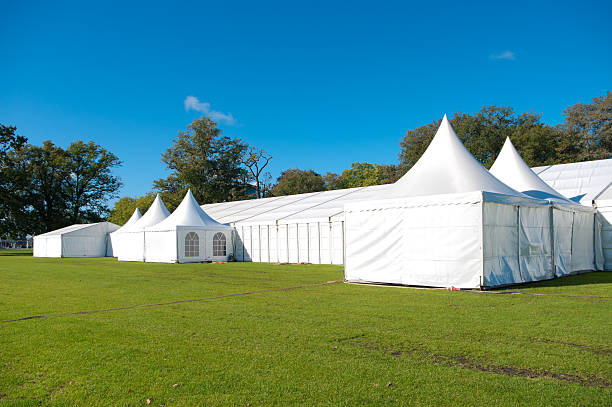
A major commercial benefit of modular party tents is the opportunity to share compatible components across multiple configurations.
For event rental businesses, inventory costs do not come only from purchasing complete tents. Separate accessories, replacement parts, storage space, and maintenance also contribute to long-term operating expenses.
4.1 Standardized Components Improve Inventory Utilization
A well-planned modular tent system can use common components across multiple tent lengths.
Depending on the manufacturer’s design, shared items may include:
- Intermediate aluminum frame sections.
- Compatible roof beams and supporting members.
- Standardized connectors and fastening hardware.
- Sidewall panels with matching attachment systems.
- Compatible gutters and drainage accessories.
- Selected doors, windows, and enclosure components.
For example, a rental company may use the same intermediate frame sections for several tent lengths. It can then add or remove sections according to individual event requirements.
This reduces the need to maintain separate complete frame inventories for every tent size.
4.2 How Modular Design Helps Reduce Inventory Costs
Consider a rental business that frequently receives orders for 10 × 15m, 10 × 20m, and 10 × 30m structures.
If each size uses an independent frame system, the company may need to purchase and store three separate frame inventories.
A compatible modular system can instead use standardized end frames and shared intermediate sections.
This approach may help the company:
- Reduce duplicated frame purchases.
- Improve the utilization rate of stored components.
- Simplify spare-part management.
- Reduce the number of rarely used accessories.
- Improve equipment replacement planning.
However, modular construction does not eliminate the need for complete roof covers, sidewalls, or other size-specific accessories. Fabric panels and drainage components must match the actual configuration.
4.3 Consider Compatibility Before Ordering Accessories
Not all modular tent components are interchangeable.
Even products with similar dimensions may use different connection plates, profiles, fastening positions, or fabric attachment systems.
Before ordering additional sections, buyers should confirm:
| Component | Compatibility Check |
|---|---|
| Aluminum frames | Profile dimensions, alloy, connection positions |
| Bolts and connectors | Thread size, material, fastening design |
| Roof covers | Bay dimensions, width, attachment method |
| Sidewalls | Panel height, fastening system, opening positions |
| Gutters | Roof profile, drainage direction, connection design |
| Doors and windows | Frame dimensions and attachment locations |
| Flooring interfaces | Column positions and base-plate dimensions |
A complete component compatibility list helps prevent purchasing errors and reduces installation problems.
4.4 Calculate the Real Cost of Ownership
A lower initial purchase price does not always mean a lower operating cost.
Rental businesses should compare the total cost of ownership over the expected service period.
A practical calculation includes:
Total Ownership Cost = Initial Purchase + Transportation + Storage + Maintenance + Replacement Costs
Then evaluate how much rental income each component can generate across different event configurations.
For modular systems, buyers should also consider the cost of additional roof covers, sidewalls, gutters, and connection accessories.
The goal is not simply to minimize the number of components. It is to purchase a system that supports enough profitable configurations while maintaining safe and efficient operation.
5. How to Plan Your Initial Modular Tent Fleet Sourcing
For companies entering the event rental market, purchasing a large tent inventory immediately can create unnecessary financial pressure.
A more practical strategy is to start with a standardized modular system and expand according to actual booking demand.
The first objective should be to identify the event sizes that generate the majority of customer inquiries.
5.1 Analyze Your Most Common Event Requirements
Before contacting a manufacturer, review historical bookings or expected customer demand.
Consider these questions:
- What tent widths do customers request most frequently?
- Which tent lengths are most common?
- Are weddings or corporate events your main business?
- Do customers frequently request extensions?
- Will the tents be installed indoors, outdoors, or in mixed environments?
- How many projects may require simultaneous installation?
If a rental company frequently receives orders for 10m-wide tents, it may make sense to standardize its initial inventory around that width.
This creates a consistent equipment base for future expansion.
5.2 Build a Core Module Inventory
A practical starting strategy is to select one main tent width and one standardized bay distance.
For example, a company using a 10m-wide system with 5m modules could plan its initial inventory around three common configurations.
| Target Configuration | Length | Example 5m Modules |
|---|---|---|
| Small event tent | 15m | 3 |
| Medium event tent | 20m | 4 |
| Large event tent | 30m | 6 |
The company should calculate the total number of intermediate sections required to support its expected simultaneous bookings.
It should also confirm the number of end frames, roof covers, sidewalls, connectors, and spare parts needed.
The table illustrates configuration planning rather than a complete bill of materials. Actual quantities depend on the manufacturer’s structural layout.
5.3 Use an 80% Demand Coverage Strategy
A useful procurement objective is to configure the initial fleet around the most frequently requested event sizes.
For example, if historical booking data shows that a limited group of tent dimensions accounts for approximately 80% of orders, those configurations can form the core inventory.
The remaining demand can be addressed through:
- Additional modular sections.
- Compatible extension accessories.
- Temporary equipment partnerships.
- Special-order structures for unusual projects.
The 80% figure is a planning target, not a universal industry benchmark. Each rental company should calculate its own demand distribution.
5.4 Evaluate the Manufacturer’s Engineering and Customization Support
A modular tent supplier should provide more than standard frame dimensions.
Buyers should request information about the complete structural system and its approved configurations.
Important sourcing questions include:
- What standard widths and bay distances are available?
- Can the same frame components support different tent lengths?
- Which components are shared across configurations?
- Are roof covers and sidewalls available for different layouts?
- What are the maximum approved dimensions?
- Can the supplier provide structural drawings and load calculations?
- What wind, rain, and snow conditions does the design address?
- What anchoring methods are recommended?
- Are replacement components available for future expansion?
- Can the manufacturer customize dimensions, accessories, and appearance?
A reliable sourcing decision should consider engineering documentation, component compatibility, installation requirements, and long-term replacement support.
5.5 Create a Scalable Purchasing Plan
Instead of buying every possible configuration at once, rental companies can divide procurement into stages.
Stage 1: Establish the standard system
Select the main width, bay distance, frame specifications, and basic accessories.
Stage 2: Purchase the core inventory
Acquire enough modules to cover the most common event sizes and expected simultaneous bookings.
Stage 3: Monitor rental demand
Track which configurations generate the most revenue and which components remain unused.
Stage 4: Expand strategically
Purchase additional modules, covers, and accessories according to actual booking patterns.
This staged approach helps businesses control initial investment while keeping room for future growth.
6. Frequently Asked Questions About Modular Party Tents
Q1: What is the main advantage of modular party tents?
Modular party tents allow rental companies to create different tent lengths by combining compatible structural sections. This can reduce duplicated frame inventory and improve equipment utilization.
Q2: Can one modular tent frame be extended to any length?
No. Modular systems have engineered configuration limits. Maximum length depends on frame design, connections, anchoring, environmental loads, and applicable regulations.
Q3: Is a 3m or 5m bay distance better for event rental companies?
Neither is universally better. A 3m bay distance provides smaller length increments, while a 5m bay distance uses fewer sections for the same overall length. Buyers should compare their typical event dimensions and installation requirements.
Q4: Can modular party tents share roof covers and sidewalls?
Some components may be shared, but fabric panels must match the selected configuration. Buyers should confirm dimensions, attachment methods, and compatibility with the manufacturer.
Q5: Are aluminum frame party tents suitable for repeated rental use?
Aluminum frames are widely used in commercial event structures. Their suitability depends on alloy specifications, frame dimensions, connection quality, maintenance, and the approved structural design.
Q6: What should buyers request before ordering custom modular tents?
Buyers should request structural drawings, frame specifications, configuration limits, load calculations, installation instructions, accessory compatibility information, and relevant material documentation.
Conclusion: Build a Flexible Tent Fleet Around Standardized Modules
Modular party tents provide event rental companies with a practical way to serve different event sizes through a shared structural system.
Their value comes from standardized bay sections, compatible connections, reusable frame components, and scalable inventory planning. By selecting suitable bay distances and planning common configurations, rental operators can reduce duplicated equipment purchases and improve long-term asset utilization.
However, modular flexibility must always work within the structural limits of the tent system. Frame strength, connection design, anchoring, weather resistance, fabric compatibility, and local engineering requirements should guide every purchasing decision.
For rental businesses planning to expand their equipment inventory, working with an experienced manufacturer is an important step. Upal provides large party tent engineering customization solutions for buyers who need structures tailored to different event requirements. Contact the Upal team to discuss your preferred dimensions, modular layout, and project specifications.